PbSe Infrared Detectors
It is easier to make a detector noise limited system than one might think
Start with the fundamentals: how PbSe photoconductors turn IR into signal
Instrument designers can achieve optimal operation of PbSe IR detectors by choosing the ideal bias voltage, optical chopping frequency, or a combination of the two. To explain how this is possible, first it is important to understand the basic operating concepts of Lead Selenide detectors.

Optimization for High-Performance Instrument Design
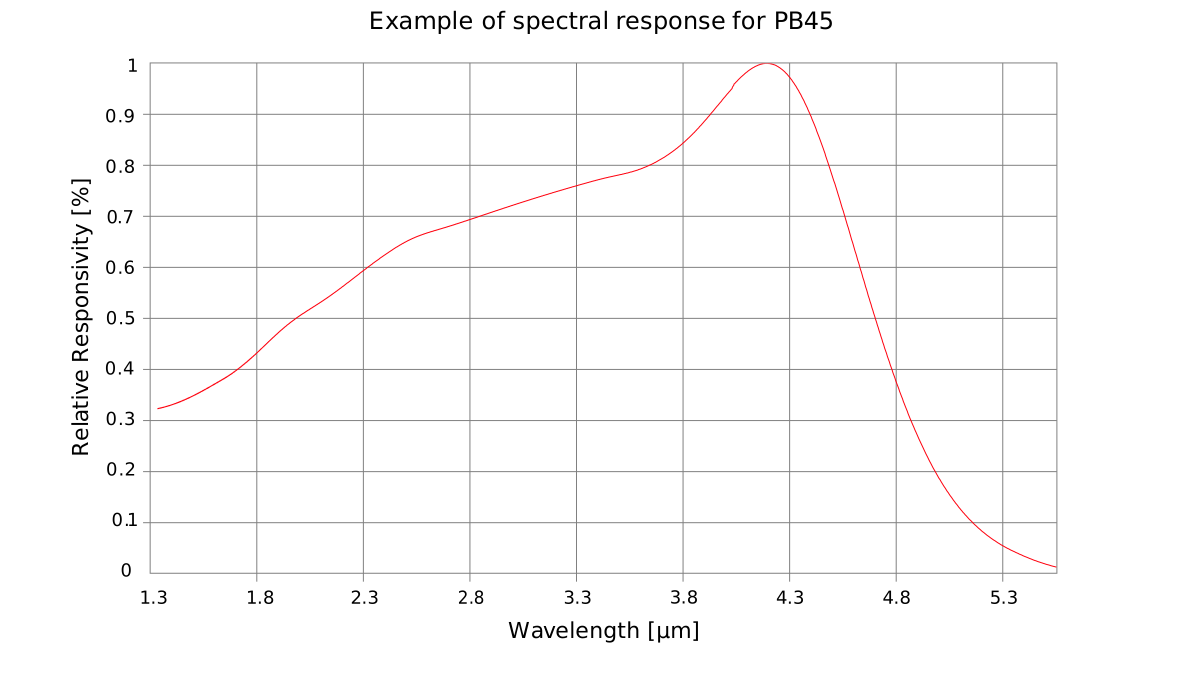
Why PbSe is a go-to detector from 1–5.2 µm: sensitivity without the cost burden
Photoconductive PbSe detectors have a spectral response from 1 – 5.2 micrometers and is the detector of choice due to its high sensitivity and relatively low cost. These detectors operate on the principle that the conductivity of the material will increase as photons incident on the polycrystalline thin film promote electrons across its bandgap through electron/hole generation. Therefore, the detector resistance will change in response to varying amounts of incident photons. When the detector is connected in series to a load resistor and a bias voltage is applied, the detector response will change the current in the circuit. The voltage drop across the load resistor is used to measure the change in current.
Since the PbSe detector resistance changes in response to incident photons and the resulting change in circuit current is how the incident energy is measured, the IR light must be chopped at a frequency, f. There is a mathematical relationship that can determine the detector responsivity (signal) when the chopping frequency, detector time constant at a particular operating temperature, and detector dark responsivity are known. Additionally, because PbSe detectors exhibit 1/f noise, the normalized signal to noise ratio, or D*(detectivity), can be determined.
Get optimum detector operation
So how can one adjust the bias voltage and chopping frequency to get optimum detector operation? The specific values are instrument and application dependent. Success has been found by many gas analysis, spectrometer, flame detection, and non-contact temperature measurement OEM designers when making their instruments detector noise limited instead of circuit noise limited. That is when true S/N (signal to noise) can be seen. The key is to understand that increasing bias voltage increases the signal in direct proportion and that decreasing the optical chopping frequency increases the detector noise level.
It is also important to know that one must apply enough bias in order to raise the noise level above the Johnson noise level of the circuit yet high bias voltages are often not practical or safe in most instruments. Neither is operating at high chopping frequencies. Often, when lowering the chopping frequency a designer can also lower the bias voltage and still have the 1/f noise component be dominant. Therefore, adjusting the bias voltage or lowering the chopping frequency or a combination of both will be the sweet spot for operating a detector noise limited system.
Designing a PbSe-based instrument?
Laser Components has a team of PbSe detector experts ready to work with instrument designers to develop custom specifications that include the ideal optical chopping frequency, bias voltage, and other potentially critical system parameters. Paying close attention to these details results in top performing instrumentation.

Downloads
Beyond Borders
News


Our IR Detectors
manufactured by LASER COMPONENTS

Complete with selected filter and other accessories.

The IA35 series photodiodes based on heterostructures were specially designed for operation at room temperature.

Infrared (IR) photodiodes with an emphasis on quantum efficiency

PbS Detectors detect infrared radiation in the wavelength range between 1 µm and 3.3 µm.

Polycrystalline lead selenide (PbSe) is a standard semiconductor detector with a sensitivity of between 1 µm and 5.2 µm.

Advanced single channel voltage mode detectors for FTIR instruments.

An IR filter makes all the difference. Thermal detectors are naturally polychromatic, and a filter is needed to detect specific gases/wavelengths.

Pyroelectric crystals generate positive and negative charge carriers simultaneously on opposing sides.

Multi-channel pyrodetectors: dual-channel, triple-channel and quad-channel versions are available.

Single channel pyroelectric detectors made of LiTaO3 are available for current mode (CM). They are used for gas detection and flame detection.

DLaTGS detectors exhibit the most effective pyroelectric effect known. Their major application is FTIR.
LASER COMPONENTS UK - Your competent partner for optical and optoelectronic components in the United Kingdom.
Welcome to LASER COMPONENTS UK Ltd., your expert for photonics components. Each product in our wide range of detectors, laser diodes, laser modules, optics, fiber optics, and more is worth every Pound (£/GBP). Our customized solutions cover all conceivable areas of application: from sensor technology to medical technology. You can reach us here:
4 William House, Old St Michaels Drive
Braintree CM7 2AA
United Kingdom
Phone: +44 1245 491 499
Email: info(at)
